Fixing Activation Drift in Kalium Channelrhodopsins
When KCRs were discovered in 2022, they promised to revolutionize neuronal silencing. Finally we had a light-gated potassium channel that could inhibit neurons in a similar way to endogenous K+ channels. Various groups pioneered engineering variants with improved K+ selectivity (WiChR, KALI1, KALI2) each showing progressively better specificity and higher conductance.
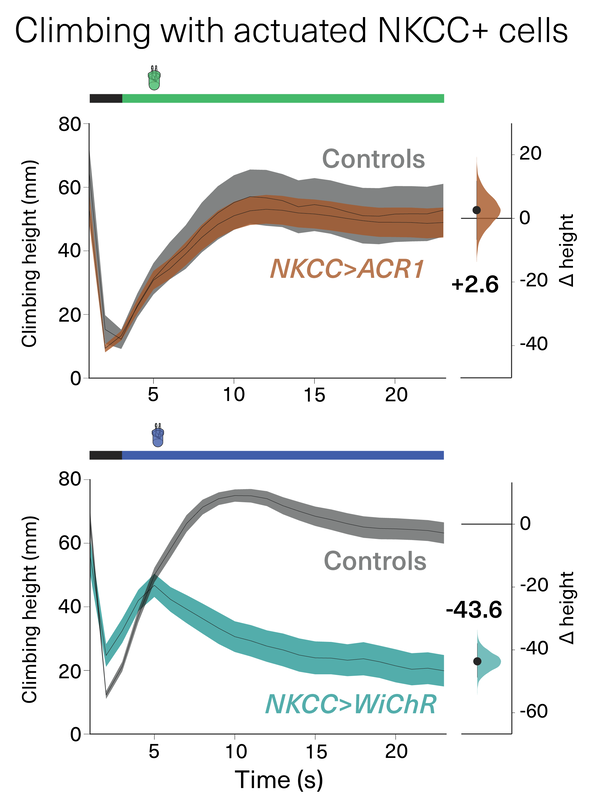
But something didn't add up; a report from worms showed, under certain conditions, behavior consistent with undesirable activation. Now, our systematic evaluation in flies and worms shows why: during continuous illumination, many KCRs’ potassium selectivity declines. Indeed, as time wears on and sodium conductance rises, each can shift from acting as an inhibitor to becoming an activator.
This suggests that KCRs have an Achilles heel—but for one exception. Among all variants tested, KCR1-C29D, a single point mutation made by the Hegemann group, outperformed the heavily engineered versions. Across light intensities and durations, C29D maintains stable inhibition, providing reliable silencing.
The TL;DR of the paper:
→ Ion selectivity stability matters more than absolute selectivity
→ Light intensity and illumination duration affect KCR function
→ Sometimes high conductance can be too much of a good thing
→ Sometimes simpler mutations work better than complex engineering
This work bridges the gap between biophysical characterization and applications in neural circuit analysis. It shows why systematic validation remains essential, especially when everyone is excited about a new tool.
🔗 Read more at Advanced Science: https://doi.org/10.1002/advs.202509180
This work was done with collaborators from labs in Würzburg, Leipzig, and Frankfurt, including Shiqiang Gao, who led this important project. Congratulations also to Zhiyi Zhang, and Stanislav Ott from my group whose work established C29D as the best inhibitor.
When KCRs were discovered in 2022, they promised to revolutionize neuronal silencing. Finally we had a light-gated potassium channel that could inhibit neurons in a similar way to endogenous K+ channels. Various groups pioneered engineering variants with improved K+ selectivity (WiChR, KALI1, KALI2) each showing progressively better specificity and higher conductance.
But something didn't add up; a report from worms showed, under certain conditions, behavior consistent with undesirable activation. Now, our systematic evaluation in flies and worms shows why: during continuous illumination, many KCRs’ potassium selectivity declines. Indeed, as time wears on and sodium conductance rises, each can shift from acting as an inhibitor to becoming an activator.
This suggests that KCRs have an Achilles heel—but for one exception. Among all variants tested, KCR1-C29D, a single point mutation made by the Hegemann group, outperformed the heavily engineered versions. Across light intensities and durations, C29D maintains stable inhibition, providing reliable silencing.
The TL;DR of the paper:
→ Ion selectivity stability matters more than absolute selectivity
→ Light intensity and illumination duration affect KCR function
→ Sometimes high conductance can be too much of a good thing
→ Sometimes simpler mutations work better than complex engineering
This work bridges the gap between biophysical characterization and applications in neural circuit analysis. It shows why systematic validation remains essential, especially when everyone is excited about a new tool.
🔗 Read more at Advanced Science: https://doi.org/10.1002/advs.202509180
This work was done with collaborators from labs in Würzburg, Leipzig, and Frankfurt, including Shiqiang Gao, who led this important project. Congratulations also to Zhiyi Zhang, and Stanislav Ott from my group whose work established C29D as the best inhibitor.